
Bafflesorption Installation Guide & Technical Specification
Download this as a PDF file here
INSTALLATION
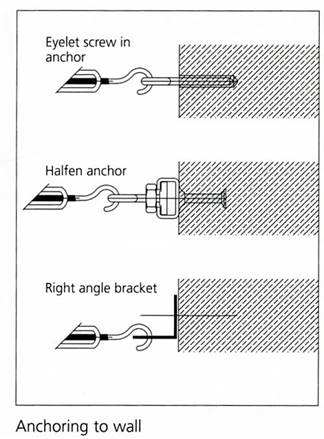
The anchoring turn-buckle bolts at both ends of the cables are attached to the desired anchoring system (right angle bracket, Halfen anchor or eyelet screw) at the calculated row spacing position and height.
The steel cable is attached to one side complete with the cable eye stiffener and cable leading using the lead-sealing pliers. An additional suspension bolt is recommended for cable lengths exceeding 10 metres. The cables are suspended at the calculated mean distance between rows.
The unattached ends of the steel cable are then fitted with the turn-buckle suspension bolt and cable eye stiffener and the cable leading is attached as described in step 2. The turn buckle bolt is then attached to the wall mount and tightened.
The ECO sound absorbers with factory mounted corkscrew suspension eyelet hooks are hung from the cable. The spacer units are clipped onto the cable between the acoustic absorbers. The sound absorbers and spacers are then manually slid down the cable. The procedure is repeated until the calculated number of acoustic sound absorbers per cable has been strung.
The suspension turn-buckle bolt is then re-tightened to minimise sagging in the cable. In some cases where the cable length requires, an additional support anchor may be required. We recommend using an easy to adjust suspension brace with hook.
(See detailed info below)
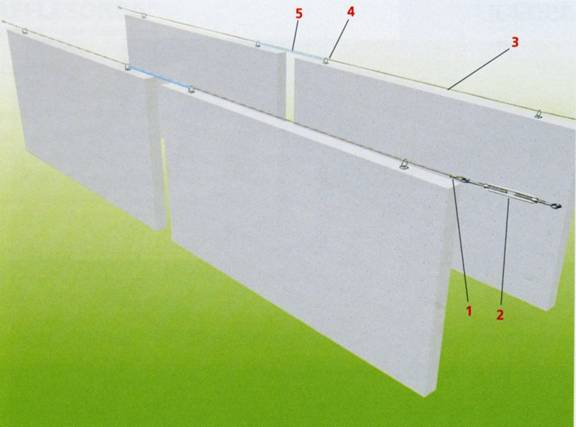
1 Cable eye stiffener, galvanised, with cable leading, aluminium, galvanised.
2 Suspension turn-buckle bolt, galvanised.
3 Steel cable, galvanised, 2.5mm diameter.
4 Corkscrew-type suspension eyelet hooks, galvanised.
5 Spacer, 300mm standard length.
Technical Information
Building Material Classification
Fire rating for the acoustic baffles is Class 0 in accordance with BS 476.
The material is available to fulfill especially stringent building material classification requirements.
Bafflesorption is made of a soft melamine resin-based foam.
Service
We work in conjunction with recognised acoustic engineering offices. Upon request, acoustic calculations
may be conducted to determine the recommended quantities of material to be utilised.

