
BB93 and Noise Control in Schools
Click HERE to download our detailed guide on sound insulation solutions for schools. This guide will take you through all the common areas within a school and will advise on the best acoustic products for classrooms, school halls, corridors and offices.
Since 2003, the Building Regulations Part E ‘’Resistance to the Passage of Sound’’ was expanded to include sound insulation, reverberation and indoor noise levels. All new schools now require provision to reduce the noise problems traditionally encountered in schools. These new rules apply to all new schools and are now subject to on-site inspections. This is because recent studies have shown that children are suffering due to their inability to hear clearly what is being said and taught in most teaching areas. Many existing schools can also be upgraded if funds allow to make the acoustic environment in all teaching areas more suitable and up to date.
Part E and Building Bulletin 93
Part E of the 2003 Building Regulations now include school buildings for installation of sound absorbing materials to reduce reverberation of noise problems which can affect a child's ability to learn.
Section 1 of Building Bulletin 93 (BB93) describes the 'Specification of Acoustic Performance' which gives the performance targets for compliance with Part E (as amended)
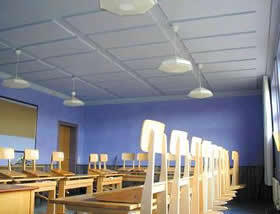

"Each room or other space in a school building shall have the acoustic conditions and the insulation against disturbance by noise appropriate to its normal use"
BB93 aims are as follows:
- To provide a regulatory framework for the acoustic design of schools in support of the Building Regulations.
- Give supporting advice and recommendations for planning and design of schools.
- Provide a comprehensive guide for architects, building control officers, building services engineers, clients and others involved in the design of new school buildings.
Reasons why some classes require sound absorbing insulation
There are four main reasons why a classroom will require the installation of sound absorbing materials:
- Speech cannot easily be understood due to excessive reverberation.
- The design and shape of the classroom may distort speech.
- Lessons may be disturbed due to noise being heard from outside of the class. Reverberant sound or 'echo' is created by sounds such as speech bouncing off surrounding hard surfaces. This has the affect of distorting the sound often making it difficult for pupils to comprehend what the speaker is saying. This results in speech reaching a pupil's ears from many directions and the echo clouds its clarity.
- Reverberation in classrooms and school halls can be a particular problem to pupils with hearing difficulties.
Click HERE to download our detailed guide on solutions for schools.

