
HOW TO SOUNDPROOF A ROOM
Soundproofing a room is something we are often asked how to do but it is not always possible to completely soundproof a room within a domestic property. However, if the following advice is taken, reasonable levels of soundproofing can be achieved which will reduce any noise nuisance from your neighbours or outside.
WINDOWS
If light through the windows is desired, they should be triple glazed with different thicknesses of glass at staggered intervals and installed so as to be completely sealed. For best results, at least one pane should be of laminated glass. If light is not an issue, the window reveal can ideally be blocked up. As this is a fairly permanent option, it may be preferred to block up the window with a more easily removable alternative when required.
In this case we would suggest two layers of our high density Acoustic Plasterboard is fitted into the reveal, one immediately behind the other and tight to the window. The remaining void should be filled with our Acousticel M20AD and another two layers of Acoustic Plasterboard fixed over the top sandwiching the M20AD sound insulation.
A lighter removable plug can be used instead and whenever required, but it must still be an airtight fit when installed so may require draught proofing seals. If the window is large, this type of sound blocking plug may be too heavy or unwieldy to handle so a compromise such as hinged sound insulated shutters may have to be fitted instead. For more info on window soundproofing click here
WALLS
Party walls and any other walls should be soundproofed as required and before anywhere else and can be upgraded with our Acousticel M20AD recycled rubber product if space is at a premium. However, it must be noted that modern properties with cavity walls and built with more lightweight materials may allow flanking noise around party walls. For a more efficient result, independent soundproofed stud walls should be constructed using 75mm stud installed 25mm away from existing walls.
Our SoundBlocker Quilt fixed between the studs will give best results but 100mm of Acoustic Mineral Wool insulation fitted into the cavity of the stud wall will also give quiet good sound insulation. More information on how to soundproof a wall can be viewed by clicking here
CEILINGS
Soundproofing of ceilings is usually best carried out after the walls have been treated unlike beneath timber suspended floors that should be treated first. See section on soundproofing floors in next section. If there is sufficient ceiling height, the best method of soundproofing is to incorporate a new suspended ceiling beneath the existing and supported on new joists suspended from wall mounted hangers and not touching the original ceiling.
Our SoundBlocker Quilt or Acoustic Mineral Wool (AMW) can be fitted between the joists and the underside clad with two layers of our Acoustic Plasterboard fixed with our Resilient Bars. For an enhanced result, our SBM5 Soundproofing Mat can be sandwiched between the layers.
In many cases this is impractical so a good alternative is to use our Resilient Bar system supported on battens or directly to the underside of the structural joists after the initial plasterboard ceiling has been removed. For more info on ceiling soundproofing click here
FLOORS
If the room to be insulated is on the first floor, the ceiling below must first be soundproofed with our Resilient Bar system if possible. Acoustic mineral wool should be installed between the joists and if the floor is of the square edged variety, it can be overlaid with SBM5 to seal up the joints. A floating floor using Acousticel R10 as the resilient layer with a new t&g floor installed on top should now be installed. For more info on floor soundproofing click here
DOORS
Normal domestic doors are too light and ill fitting to provide effective sound insulation. If more sound insulation is required, the doors can be replaced with heavier fire doors and fitted so as to be airtight when closed which will require the fitting of an acoustic threshold. A good seal can be achieved using our Acoustic Seals or Acoustic Doorsets. Mortice locks and open holes through the door should be avoided.
DOUBLE DOOR ENTRY
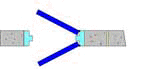
A double door entry system will be more effective at reducing noise breaking through. This entails two heavy fire doors fitted so one opens outwards and the other opens inwards. Both should be fitted so as to be acoustically sealed when closed using our Acoustic Doorseal Kits as previously described. A good seal can be achieved using our Acoustic Seals or Acoustic Doorsets.
EXPECTED RESULTS
Before installing soundproofing as described above, your room would have had a very poor insulation value which would no doubt, be very disturbing for your neighbours.
The newly soundproofed room will substantially reduce noise nuisance to other rooms but it must be appreciated that loud noise may still be heard, particularly low frequency sounds as produced by drums.
REVERBERATION
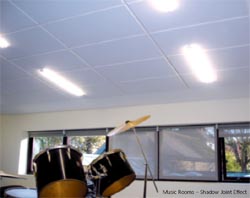
Now the room has been soundproofed, you will want to reduce the reverberation or echo within it. Reverberation amplifies any noise originally produced so the sound has to be absorbed to reduce this. To achieve this we recommend Echosorption Plus a very efficient sound absorber is used to line the upper walls and ceiling. This will reduce the reverberation and also the amount of noise breaking out of the room.
VENTILATION
Now the room has been soundproofed and internal reverberation has been taken care of adequate ventilation may be required. Normally two 40dB Acoustic Vents are installed diametrically opposite one another. Additional trunking may have to be built using 18mm MDY or ply and lined on the inside with sound absorbing foam to increase the sound insulation of the vents to a higher level.
For more information on prices, go to Soundproofing prices or ring Sound Service (Oxford) Ltd directly on 0845 363 7131 at local call cost from most landlines or 01993 704981 from mobiles.
Written by Stephen Young
© Sound Service (Oxford) Ltd. 2003

